1. Challenge
Diverless UWILD crack detection and sizing across 70 structural locations. Supporting a life extension survey.
2. Solution
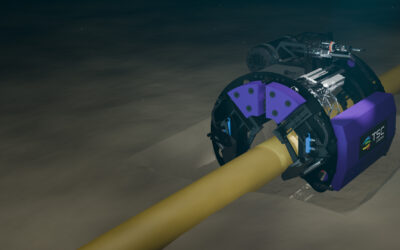
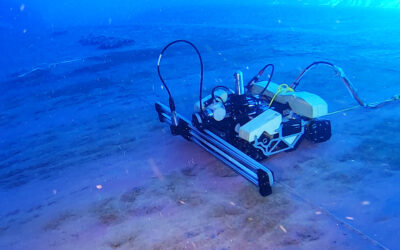
Deck-launched deployment using a compact ROV and robotic MagCrawler equipped with ACFM® array probes.
3. Result
Delivered high-confidence integrity data to support life extension, without divers or a dedicated inspection vessel.
The Challenge
The client wanted to minimise offshore logistics by completing the campaign using equipment launched directly from the MOPU. The objective was to deliver the inspection safely and efficiently, without divers or a dedicated inspection vessel, while maintaining reliable access to all required inspection locations.
The inspection scope comprised 70 locations across all three MOPU legs, including leg-to-casting welds, casting-to-tank welds, circumferential seams and pinhole support locations. The inspection locations spanned water depths from approximately 10 to 70 metres and included a variety of structural geometries, requiring reliable inspection data to support a life extension survey.

What is a MOPU?
A Mobile Offshore Production Unit (MOPU) is a self-contained offshore production facility, often converted from a jack-up drilling rig. Supported by three or more lattice legs resting on the seabed, these assets remain fixed in position while producing and processing oil and gas from offshore fields. Many MOPUs remain in service beyond their original design life, making structural integrity inspections and life extension programmes essential.
The Solution
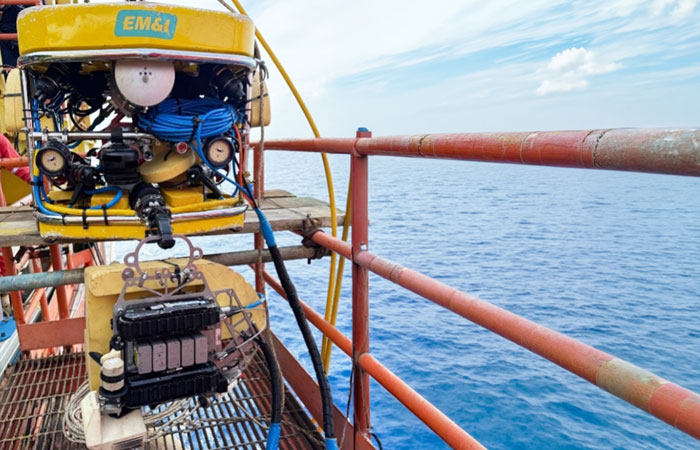
Partnering with EM&I, TSC Subsea delivered the inspection programme using a compact, deck-launched deployment model. The complete inspection spread was launched directly from the MOPU using EM&I’s compact deck-launched observation and light intervention class ROV (IMCA Class IIb), removing the need to mobilise a dedicated inspection vessel.
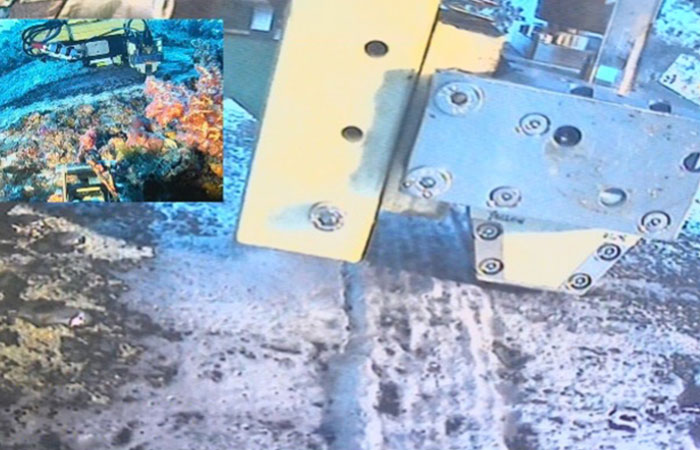
Before deploying the MagCrawler™, the compact ROV removed localised marine growth at each inspection location to expose the inspection area. Once prepared, the ROV deployed the MagCrawler onto the structure to perform the ACFM® inspection.
Why ACFM?
Alternating Current Field Measurement (ACFM) was selected because it enables reliable detection and sizing of surface-breaking cracks in welded structures with only localised surface preparation. Unlike some conventional inspection techniques, extensive cleaning to bare metal is not required, making ACFM well suited to robotic subsea deployment where efficient inspection and minimal intervention are important.
Equipped with proprietary ACFM array probes, the MagCrawler attached magnetically to the structure and traversed each inspection location, maintaining controlled probe contact to acquire high-quality inspection data.
A range of MagCrawler probe attachments was utilised to accommodate the different weld geometries encountered, providing efficient access to structural welds, circumferential seams and pinhole locations across the MOPU.
Why were pinhole locations inspected?
On jack-up type MOPUs, the pinhole support locations form part of the leg jacking and support system, where significant structural loads are transferred between the hull and legs. Alongside critical structural welds, these locations are considered key structural features and are routinely included within life extension and structural integrity inspection programmes to verify that no surface-breaking cracks are present.

Drawing on decades of subsea ACFM experience, TSC Subsea provided the inspection personnel, procedures and robotic deployment methodology required to deliver consistent, high-quality inspection data throughout the campaign.
The Results
The campaign successfully completed the planned inspection programme, with 70 locations inspected in accordance with the agreed scope.
High-quality ACFM data was acquired across all planned inspection locations, providing the operator with the information needed to assess the condition of critical structural welds and support ongoing asset integrity management.
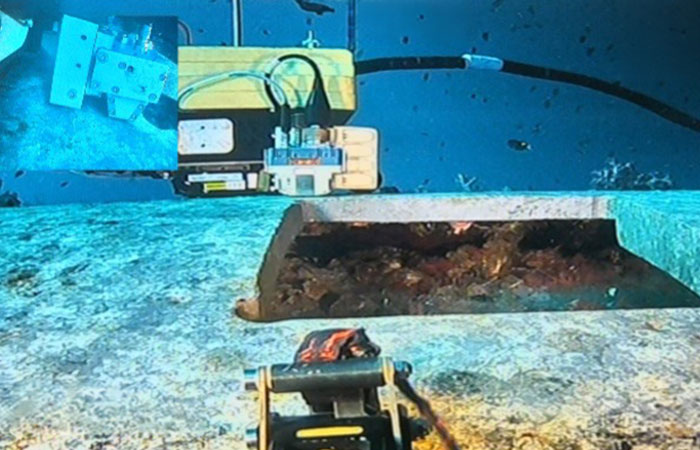
The project demonstrated that advanced subsea crack inspection can be successfully delivered using equipment launched directly from the client asset. By eliminating the need for a dedicated inspection vessel, the approach simplified offshore logistics, reduced mobilisation requirements and supported a more efficient use of offshore resources while maintaining the inspection quality required for a UWILD and life extension programme.
Looking for a similar solution?
Whether you’re planning a UWILD programme, life extension survey or challenging structural inspection, our engineering team can help identify the most suitable robotic deployment and NDT solution.